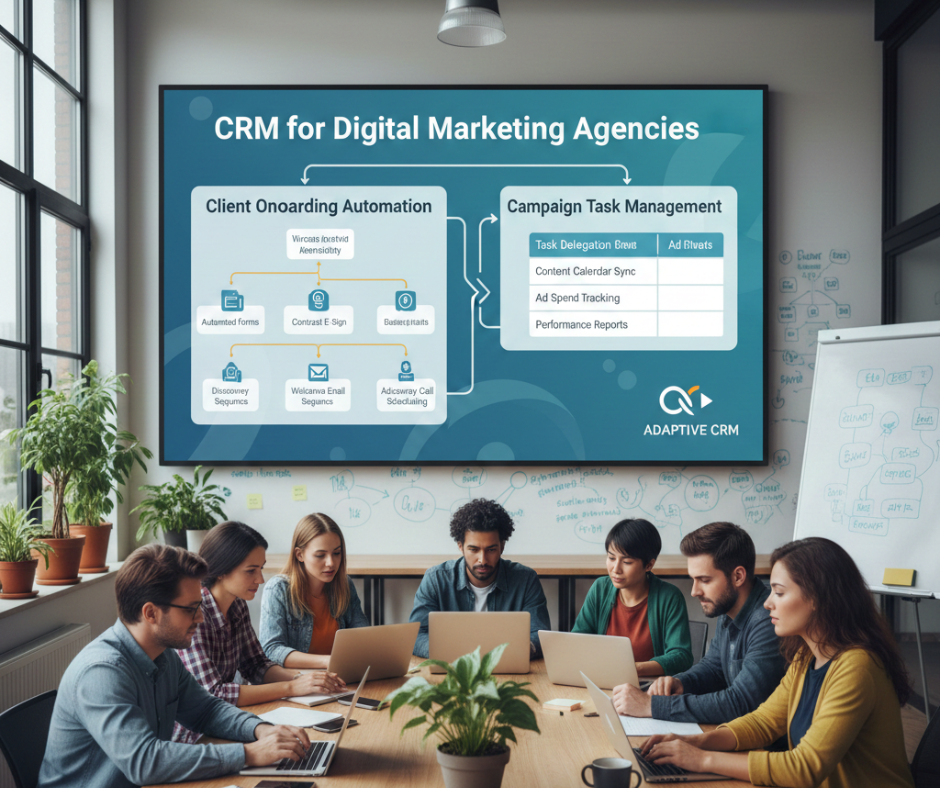

Digital marketing agencies operate in a fast-paced, multi-channel environment. Managing client onboarding, campaign execution, reporting, and communication manually can quickly become overwhelming—especially as the agency scales. This is why modern agencies are turning to CRM systems designed specifically for digital marketing workflows.
A powerful CRM doesn’t just store client data; it automates onboarding, streamlines campaign tasks, improves collaboration, and delivers real-time visibility across all projects. For digital marketing agencies, CRM automation is no longer a luxury—it’s a competitive advantage.
What Is a CRM for Digital Marketing Agencies?
A CRM (Customer Relationship Management) system for digital marketing agencies is a centralized platform that manages:
- Client information
- Onboarding workflows
- Campaign tasks and timelines
- Communication and approvals
- Performance tracking and reporting
Unlike generic CRMs, agency-focused CRMs are built to support marketing operations across SEO, PPC, social media, content, email, and paid advertising.

Why Agencies Need CRM Automation
As agencies grow, common challenges include:
- Disorganized client onboarding
- Missed deadlines and approvals
- Poor task visibility across teams
- Scattered communication
- Manual reporting
CRM automation solves these issues by creating structured, repeatable workflows that reduce errors and save time.
Automating Client Onboarding
1. Streamlined Client Intake
CRMs automate the client intake process by collecting all essential information through digital forms. This includes:
- Business details
- Brand guidelines
- Marketing goals
- Access credentials
- Target audience data
All information is stored centrally, eliminating email back-and-forth.
2. Automated Welcome and Setup Tasks
Once a client is onboarded, the CRM can automatically:
- Send welcome emails
- Assign onboarding tasks
- Create project timelines
- Notify internal teams
This ensures every client receives a consistent, professional onboarding experience.
3. Faster Contract and Approval Workflows
CRM systems integrate with e-signature tools and approval workflows, allowing:
- Faster contract execution
- Clear scope confirmation
- Reduced onboarding delays
This speeds up project kick-off and improves client confidence.
Automating Campaign Management Tasks

Centralized Campaign Planning
A CRM provides a unified dashboard to plan and manage campaigns across channels:
- SEO
- Google Ads
- Social media
- Email marketing
- Content marketing
Teams can see timelines, responsibilities, and dependencies in one place.
Task Assignment and Workflow Automation
CRM automation allows agencies to:
- Auto-assign tasks based on campaign type
- Set deadlines and reminders
- Trigger next steps automatically
- Track task progress in real time
This reduces micromanagement and keeps campaigns moving smoothly.
Approval and Feedback Management
Client approvals are often a bottleneck. CRM systems simplify this by:
- Centralizing feedback
- Tracking approval status
- Sending automated reminders
- Maintaining revision history
This minimizes delays and miscommunication.
Improved Collaboration Across Teams
CRM platforms break down silos by enabling:
- Shared access to campaign data
- Internal comments and notes
- Clear accountability
- Cross-team visibility
Designers, marketers, strategists, and account managers can collaborate seamlessly.
Performance Tracking and Reporting Automation
CRMs integrate with marketing tools to provide:
- Real-time performance dashboards
- Automated KPI tracking
- Scheduled client reports
- ROI insights
This allows agencies to demonstrate value clearly and consistently.
Client Communication and Relationship Management
A CRM centralizes all client interactions:
- Emails
- Calls
- Meetings
- Notes and follow-ups
Automated follow-ups ensure no opportunity or concern is overlooked, strengthening long-term client relationships.
Scalability for Growing Agencies
As agencies scale, CRM systems support growth by:
- Standardizing processes
- Reducing operational overhead
- Supporting multiple clients and campaigns
- Maintaining quality and consistency
Automation allows agencies to take on more clients without increasing workload proportionally.
Security and Data Management
Agency CRMs provide:
- Role-based access control
- Secure client data storage
- Activity tracking
- Compliance with data protection standards
This protects both agency and client information.
The Future of CRM in Digital Marketing Agencies
Next-generation CRMs are evolving with:
- AI-driven campaign insights
- Predictive workload management
- Automated optimization suggestions
- Deeper tool integrations
These advancements will further transform how agencies operate and scale.
Conclusion
A CRM tailored for digital marketing agencies transforms client onboarding and campaign management from a manual, fragmented process into a streamlined, automated system. By reducing administrative tasks, improving collaboration, and delivering real-time insights, CRM automation empowers agencies to focus on what matters most—driving results for clients.
For agencies looking to scale efficiently and deliver consistent performance, CRM automation is the foundation of long-term success.




Leave a Reply