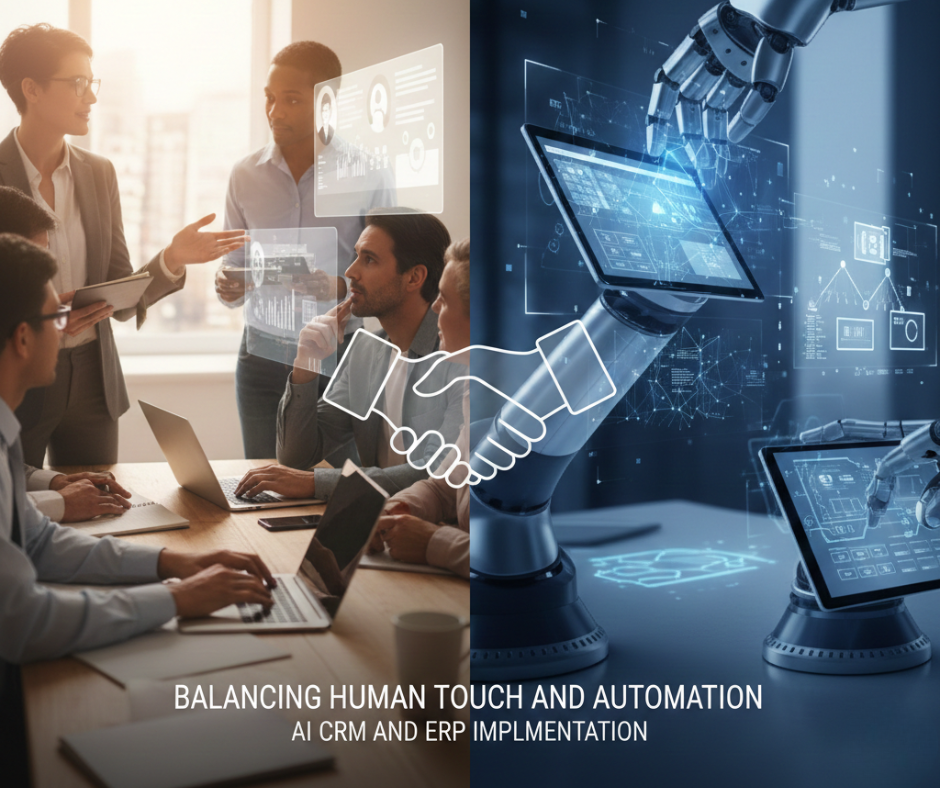

As artificial intelligence becomes deeply embedded in modern CRM and ERP systems, businesses face a critical question: how do you automate without losing the human touch?
Automation promises speed, efficiency, accuracy, and cost savings. Human interaction delivers empathy, trust, creativity, and relationship-building. The most successful organizations in 2026 aren’t choosing one over the other — they’re balancing both intelligently.
This blog explores how businesses can strike the right balance between AI-driven automation and human involvement when implementing AI-powered CRM and ERP systems.
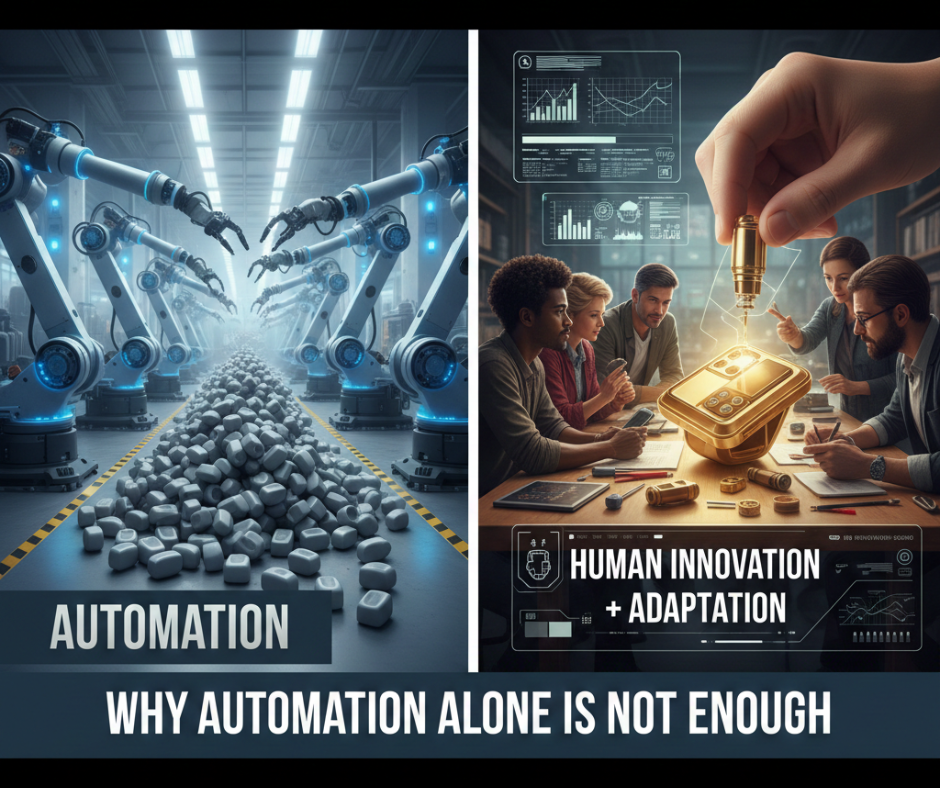
Why Automation Alone Is Not Enough
AI-powered CRM and ERP platforms can automate tasks such as:
- Lead capture and qualification
- Inventory forecasting and demand planning
- Invoice processing and financial reporting
- Customer segmentation and campaign execution
- Predictive analytics and performance dashboards
These capabilities dramatically reduce manual workload. However, over-automation creates risks, including:
- Robotic customer interactions
- Loss of emotional intelligence in customer service
- Reduced employee engagement
- Blind trust in AI decisions without human oversight
Customers still expect empathy. Employees still need control. Automation should support people — not replace them entirely.
The Value of Human Touch in CRM and ERP Systems
Human involvement adds value where AI cannot fully replicate human judgment:
1. Emotional Intelligence and Relationship Building
CRM systems can predict customer behavior, but humans understand tone, emotion, and context. Handling complaints, negotiations, and high-value clients still requires a personal approach.
2. Strategic Decision-Making
ERP analytics can suggest optimal actions, but final decisions — such as market expansion, pricing strategy, or vendor selection — benefit from human experience and intuition.
3. Ethical and Contextual Judgment
AI operates on data patterns. Humans consider ethics, brand values, and long-term reputation when making decisions.
4. Trust and Accountability
Customers and employees trust businesses more when humans remain visible in the process, especially in finance, healthcare, and customer support.
Where Automation Delivers the Most Impact
To maintain balance, businesses should automate process-heavy, repetitive, and data-driven tasks, including:
- Data entry and validation
- Order processing and scheduling
- Inventory restocking alerts
- Automated follow-ups and reminders
- Financial reconciliations
- Predictive maintenance notifications
Automation here reduces errors, saves time, and frees employees to focus on higher-value work.
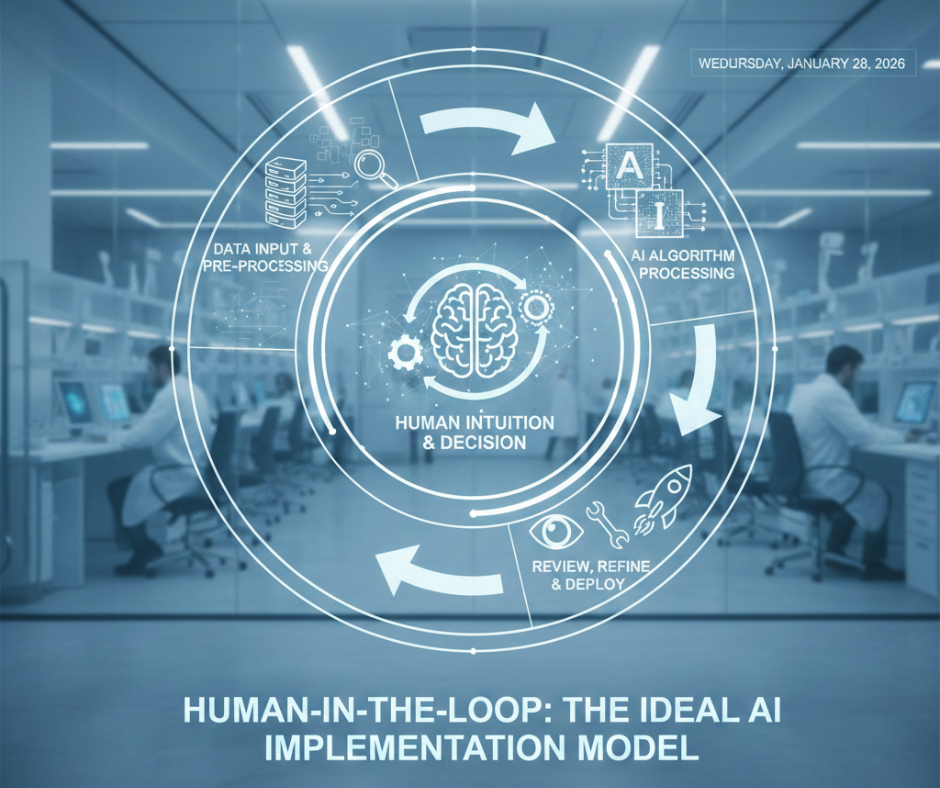
Human-in-the-Loop: The Ideal AI Implementation Model
The most effective AI CRM and ERP systems follow a Human-in-the-Loop (HITL) approach:
- AI recommends actions
- Humans review, approve, or override
- AI learns from human decisions
- Systems continuously improve over time
For example:
- AI suggests a discount → sales manager approves
- AI flags a fraud risk → finance team investigates
- AI predicts customer churn → account manager intervenes
This model ensures control, accountability, and trust.
Designing Customer Experiences That Feel Human
AI CRM platforms should enhance — not replace — human interaction:
Smart Automation, Not Cold Automation
- Use AI chatbots for FAQs and basic queries
- Seamlessly hand over complex cases to human agents
- Personalize responses using customer history
Context-Aware Communication
AI should provide agents with insights such as:
- Customer sentiment
- Purchase history
- Previous issues
- Preferred communication channels
This empowers humans to deliver faster, more meaningful conversations.
Employee Experience Matters Too
ERP automation often raises fears of job loss. Smart implementation focuses on role evolution, not elimination.
How AI ERP Empowers Employees
- Reduces manual reporting and admin work
- Provides real-time insights for better decisions
- Enables cross-department collaboration
- Improves accuracy and compliance
Employees move from data processors to decision-makers, improving job satisfaction and productivity.
Governance, Transparency, and Control
Balancing automation and human touch also requires strong governance:
- Clear rules on when AI can act autonomously
- Defined escalation paths to humans
- Explainable AI outputs
- Regular audits of AI decisions
- Data privacy and security controls
This ensures AI remains a trusted assistant, not a black box.
Best Practices for Balanced AI CRM & ERP Implementation
To get it right, businesses should:
- Start with business goals, not technology
- Automate tasks, not relationships
- Keep humans in decision-critical workflows
- Train teams to work alongside AI
- Continuously review AI performance
- Gather customer and employee feedback
- Scale automation gradually
A phased approach prevents disruption and builds confidence across teams.
The Future: Augmented Intelligence, Not Artificial Replacement
The future of CRM and ERP isn’t about choosing between humans and machines — it’s about augmented intelligence, where:
- AI handles speed, scale, and data
- Humans handle empathy, creativity, and strategy
Businesses that balance both will deliver:
- Better customer experiences
- Smarter operations
- Stronger employee engagement
- Sustainable growth
Final Thoughts
Balancing human touch and automation in AI CRM and ERP systems is not a technical challenge — it’s a leadership and design decision.
Organizations that treat AI as a collaborator rather than a replacement will build systems that are efficient and human-centered. In 2026 and beyond, success belongs to businesses that combine intelligent automation with authentic human connection.




Leave a Reply