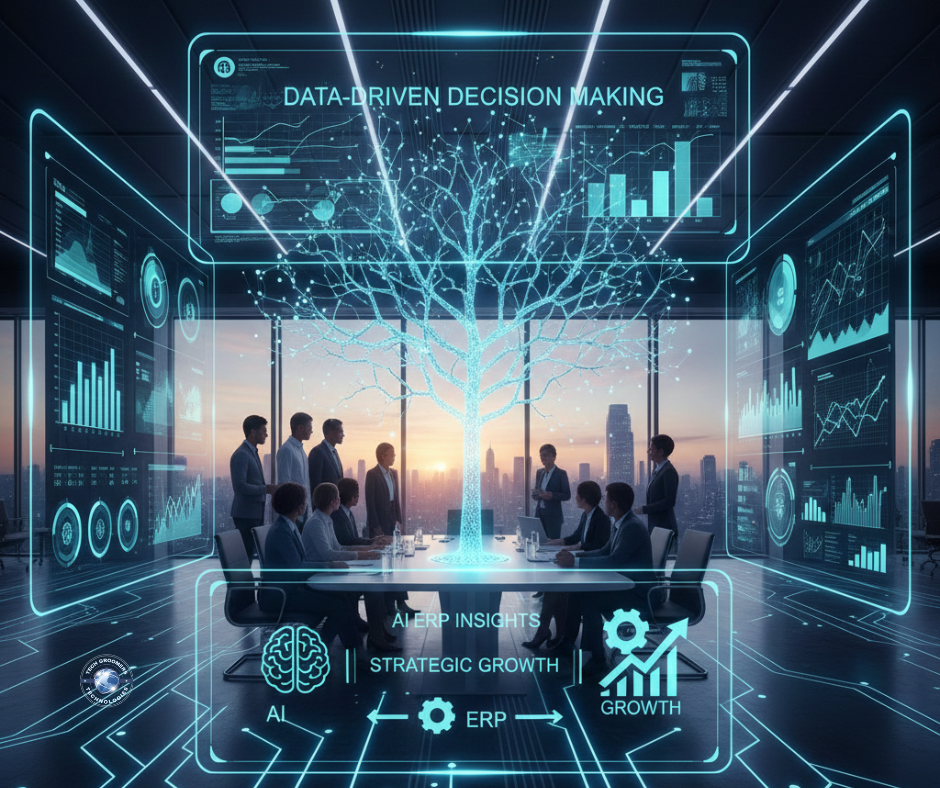

In today’s competitive business environment, decisions made on intuition alone are no longer enough. Organizations that rely on accurate data, real-time insights, and predictive intelligence consistently outperform those that don’t. This shift has made AI-powered ERP (Enterprise Resource Planning) systems a critical tool for modern businesses aiming for sustainable and strategic growth.
AI-driven ERP platforms go beyond traditional reporting. They transform raw operational data into actionable insights, enabling leaders to make smarter, faster, and more confident decisions.
The Evolution from Traditional ERP to AI-Driven ERP
Traditional ERP systems focus on data collection and process automation. While effective for record-keeping, they often fall short when it comes to strategic decision-making. Reports are static, insights are delayed, and forecasting is limited.
AI-powered ERP systems change this paradigm by embedding machine learning, predictive analytics, and intelligent automation into core business workflows. Instead of asking “What happened?”, businesses can now ask “What will happen next—and what should we do?”
Why Data-Driven Decisions Matter More Than Ever
Modern businesses generate massive amounts of data across departments—sales, finance, inventory, HR, supply chain, and customer interactions. Without AI, much of this data remains underutilized.
Data-driven decision-making allows businesses to:
- Reduce operational risks
- Identify growth opportunities early
- Optimize costs and resource allocation
- Improve customer satisfaction
- Respond quickly to market changes
AI ERP systems make this possible by delivering real-time intelligence rather than outdated reports.
1. Real-Time Business Intelligence
AI ERPs continuously analyze live data streams across all departments. Executives gain instant visibility into KPIs, financial performance, inventory health, and workforce productivity.
This eliminates delays and enables proactive decision-making instead of reactive problem-solving.
2. Predictive Analytics for Strategic Planning
Using historical data and pattern recognition, AI ERP systems can forecast:
- Sales trends and revenue growth
- Demand fluctuations
- Inventory shortages or overstock risks
- Cash flow and financial health
- Workforce needs
These predictions help businesses plan months ahead with confidence.
3. Smarter Financial Decision-Making
AI-driven ERP platforms analyze financial data to:
- Detect anomalies or potential fraud
- Optimize budgeting and expense management
- Improve profit margin forecasting
- Support investment and expansion decisions
Finance teams gain deeper insights without manual data crunching.
4. Operational Optimization Across Departments
AI ERP insights reveal inefficiencies that are often invisible in traditional systems. Businesses can:
- Identify process bottlenecks
- Optimize supply chain operations
- Improve vendor performance
- Reduce downtime and waste
This leads to leaner operations and higher productivity.
5. Customer-Centric Growth Strategies
By integrating CRM data into ERP analytics, AI systems provide a 360-degree view of customer behavior. Businesses can:
- Identify high-value customers
- Predict churn risks
- Optimize pricing strategies
- Align inventory and production with customer demand
This ensures growth strategies are aligned with real customer needs.
Breaking Data Silos with AI ERP Platforms
One of the biggest challenges in decision-making is fragmented data. AI ERP systems unify data from multiple departments into a single intelligent platform.
Sales, finance, operations, and HR all work from the same source of truth—ensuring decisions are aligned across the organization and reducing miscommunication.
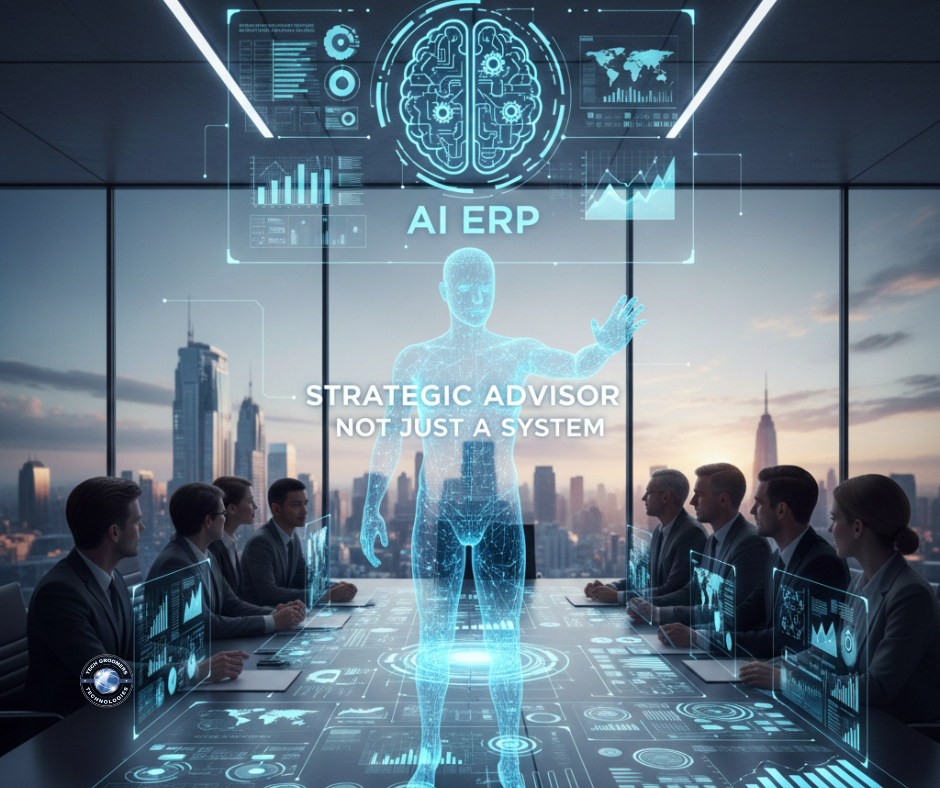
AI ERP as a Strategic Advisor, Not Just a System
Modern AI ERPs act like digital advisors. They don’t just present data—they recommend actions.
For example:
- Suggesting when to reorder inventory
- Recommending cost-cutting opportunities
- Highlighting underperforming products or regions
- Advising workforce adjustments based on demand
This guidance empowers leadership to make strategic decisions faster and with greater accuracy.
Scalability and Long-Term Growth
As businesses grow, complexity increases. AI ERP systems scale effortlessly by:
- Handling larger data volumes
- Supporting multi-location operations
- Adapting to new workflows
- Learning continuously from evolving data
This makes AI ERP an ideal foundation for long-term strategic growth.
Industries Benefiting Most from AI ERP Insights
AI-powered ERP systems are transforming decision-making across industries, including:
- Retail and eCommerce
- Manufacturing
- Automotive and logistics
- Healthcare
- Technology and SaaS
- Wholesale and distribution
Any industry that relies on complex operations and data-driven strategy benefits significantly.
Challenges and Best Practices for Adoption
To maximize the value of AI ERP insights, businesses should:
- Clean and standardize data before implementation
- Train teams to interpret AI-driven insights
- Start with high-impact decision areas
- Continuously monitor and refine AI models
Successful adoption requires both technology and organizational readiness.
The Future of Strategic Decision-Making
AI ERP systems are moving toward agentic intelligence, where systems not only provide insights but autonomously execute decisions within defined boundaries.
Future ERPs will:
- Self-optimize operations
- Adjust strategies in real time
- Anticipate market shifts automatically
- Enable near-autonomous business management
This evolution will redefine leadership and strategy in the coming years.
Conclusion
Data-driven decision-making is no longer optional—it is the foundation of competitive advantage. AI-powered ERP systems transform raw data into strategic intelligence, enabling businesses to grow smarter, faster, and more sustainably.
By leveraging real-time insights, predictive analytics, and intelligent recommendations, organizations can make confident decisions that drive long-term success in an increasingly complex business landscape.




Leave a Reply